
In the rapidly evolving world of technology, Machine Learning (ML) stands out as one of the most transformative innovations of the 21st century. From personalized shopping recommendations on Amazon to self-driving cars and medical diagnosis systems, machine learning is reshaping every aspect of life and business.
But what exactly is machine learning? How does it work? What are the different types? And why is it so integral to the future of Artificial Intelligence (AI)?
In this article, we’ll dive deep into what machine learning is, how it functions, its types, applications across industries, key benefits, challenges, and future trends — all explained simply yet comprehensively.
Understanding Machine Learning
Machine Learning (ML) is a branch of Artificial Intelligence (AI) that enables computers to learn from data and make decisions or predictions without being manually programmed for specific tasks.
Instead of explicitly following human-coded instructions, ML algorithms recognize patterns in data and use these patterns to make informed predictions or recommendations.
For example, when Netflix recommends a movie you might like, it’s not because a person told it to — it’s because a machine learning model learned your preferences from your viewing history.
Arthur Samuel, who first coined the term in 1959, described it as:
“The field of study that gives computers the ability to learn without being explicitly programmed.”
In simple terms:
- AI is the broad concept of machines simulating human intelligence.
- Machine Learning is a subset of AI that enables systems to learn automatically from data.
How Machine Learning Works
Machine learning follows a structured process involving data, algorithms, model training, and evaluation. Here’s what that process looks like:
1. Data Collection
Data is the foundation of all ML systems. It could be numerical, textual, visual, or auditory — anything that represents patterns or behavior.
Example:
- Customer purchase records for predicting future buying behavior.
- Images of animals for classification tasks.
2. Data Preparation
Real-world data is messy. It often contains missing values, duplicates, or errors. So, before training, it must be cleaned and converted into a consistent structure.
This step also includes feature selection or engineering — identifying the most informative variables that help improve model performance.
3. Selecting an Algorithm
An algorithm defines how the system will learn from data. The choice depends on the nature of the task (classification, prediction, clustering, etc.).
4. Training the Model
The chosen algorithm is trained on a dataset, meaning it adjusts its internal parameters to minimize errors.
For instance, a regression model learns how much each input variable contributes to predicting an outcome.
5. Evaluating the Model
After training, the model is tested on unseen data. Evaluation metrics such as accuracy, precision, recall, and F1-score are used to measure performance.
6. Deployment and Monitoring
Once validated, the model is deployed into real-world systems where it processes new data and generates insights. Continuous monitoring ensures accuracy doesn’t degrade over time.
Types of Machine Learning
Machine Learning isn’t one-size-fits-all. Depending on how algorithms learn from data, ML can be divided into three main types — Supervised Learning, Unsupervised Learning, and Reinforcement Learning. Some researchers also recognize Semi-Supervised Learning and Self-Supervised Learning as emerging categories.
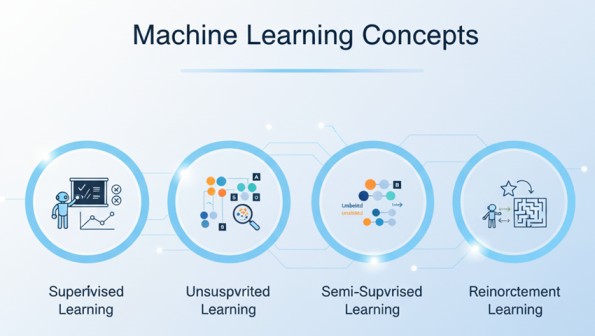
Let’s break these down clearly.
1. Supervised Learning
Supervised learning is the most commonly used type of ML. It uses labeled datasets, meaning both inputs (features) and desired outputs (labels) are known during training.
Example:
Predicting a student’s final grade based on attendance, exam scores, and homework — where past data includes both features and outcomes.
Goal:
Learn a mapping function between inputs and outputs so the system can predict results for new data.
Applications:
- Email spam filtering
- Credit scoring
- Disease diagnosis
- Weather forecasting
Popular Algorithms:
- Linear Regression
- Logistic Regression
- Decision Trees
- Random Forests
- Support Vector Machines (SVM)
- Gradient Boosting Machines (GBM)
2. Unsupervised Learning
In unsupervised learning, data doesn’t come with labels — the machine must discover hidden structures or patterns on its own.
Example:
Grouping customers into segments based on purchasing behavior, without knowing the group labels in advance.
Goal:
Identify relationships, clusters, or structures in unlabeled data.
Applications:
- Market segmentation
- Customer behavior analysis
- Fraud detection
- Topic modeling
Popular Algorithms:
- K-Means Clustering
- Hierarchical Clustering
- Principal Component Analysis (PCA)
- Association Rule Mining
3. Reinforcement Learning
Reinforcement Learning (RL) is a dynamic, goal-oriented approach where an agent learns by interacting with an environment. It takes actions, receives feedback in the form of rewards or penalties, and improves over time through trial and error.
Example:
An AI model controlling a robot learns to walk by receiving positive feedback for successful steps and negative feedback for falling.
Goal:
Maximize cumulative rewards by learning the best sequence of actions through experience.
Applications:
- Self-driving vehicles
- Game-playing AIs (e.g., AlphaGo)
- Robotics
- Supply chain optimization
Key Concepts:
- Agent: Learner or decision maker.
- Environment: The system where the agent operates.
- Reward: Feedback signal guiding the agent’s learning.
4. Semi-Supervised Learning
Semi-supervised learning combines small amounts of labeled data with large volumes of unlabeled data. It’s useful when labeling data is expensive or time-consuming — such as medical image annotation.
Applications:
- Speech recognition
- Healthcare diagnostics
- Fraud detection
Example Algorithms:
- Self-training models
- Ladder networks
5. Self-Supervised Learning (Emerging Type)
Self-supervised learning is an advanced approach where AI generates its own labels from raw, unlabeled data. This has become foundational in modern natural language processing (NLP) and computer vision systems.
Example:
Large language models like ChatGPT or BERT learn from massive text datasets without explicit human labeling by predicting missing words or sequences.
Machine Learning Algorithms: The Engines of Intelligence
Here are some widely used ML algorithms, organized by their learning types:
| Learning Type | Popular Algorithms | Typical Use Case |
|---|---|---|
| Supervised | Linear Regression, Random Forest, SVM, XGBoost | Prediction, classification |
| Unsupervised | K-Means, PCA, DBSCAN | Grouping, dimensionality reduction |
| Reinforcement | Q-Learning, Deep Q-Networks (DQN), SARSA | Robotics, games, automation |
| Semi-Supervised | Self-training classifiers | Image and speech recognition |
Each algorithm has its strengths, and choosing the right one depends on the data type, size, and business objective.
Real-World Applications of Machine Learning
Machine learning impacts nearly every industry today. Let’s explore some practical examples that show its versatility.
1. Healthcare
- Early disease detection using medical imaging.
- Predicting patient response to treatment.
- Personalizing drug discovery and genomics research.
2. Finance
- Fraud detection through anomaly detection models.
- Algorithmic trading optimizing investment portfolios.
- Risk management and credit scoring.
3. Retail & E-Commerce
- Personalized recommendation engines (Amazon, Netflix).
- Price optimization and customer retention prediction.
- Demand forecasting and inventory management.
4. Education
- Adaptive learning platforms (e.g., Duolingo).
- Predicting student dropout rates.
- Automated grading and plagiarism detection.
5. Manufacturing
- Predictive maintenance of machinery using sensor data.
- Quality assurance with visual inspection systems.
- Supply chain optimization.
6. Transportation & Logistics
- Route optimization and shipping cost reduction.
- Autonomous vehicles using deep reinforcement learning.
- Predictive safety analytics.
7. Marketing
- Lead scoring and conversion prediction.
- Customer segmentation.
- Real-time campaign performance analysis.
8. Cybersecurity
- Intrusion detection systems.
- Phishing detection in emails.
- Behavioral pattern monitoring to detect anomalies.
Advantages of Machine Learning
Machine learning delivers immense value by making processes more adaptive, intelligent, and data-driven. Here are some of its biggest benefits:
- Automation: Reduces manual effort in repetitive decision-making tasks.
- Scalability: Handles vast amounts of data and complexity efficiently.
- Predictive Power: Forecasts future outcomes based on historical patterns.
- Personalization: Provides tailor-made experiences for each user.
- Continuous Improvement: Learns and adapts over time as more data becomes available.
- Cost Efficiency: Improves productivity and reduces operational waste.
Challenges of Machine Learning
However, ML also brings significant challenges that require careful handling:
- Data Dependence: Poor data quality or availability leads to inaccurate predictions.
- Bias and Fairness Issues: Biased training data can embed discrimination in outcomes.
- Model Interpretability: Complex models like deep neural networks act as “black boxes.”
- Overfitting: Models may memorize training data instead of generalizing to new situations.
- Security Concerns: Vulnerabilities like adversarial attacks can trick ML systems.
- Ethical Concerns: Questions over privacy, accountability, and job displacement.
Organizations must establish robust AI governance, bias mitigation, and model transparency practices to ensure responsible machine learning.
Future of Machine Learning
The future of ML looks extremely promising as technology continues to evolve at lightning speed. Some exciting trends include:
- Automated Machine Learning (AutoML): Enables non-experts to build efficient models automatically.
- Edge Machine Learning: Performs computation directly on devices instead of the cloud for better privacy and speed.
- Quantum Machine Learning: Integrates quantum computing with ML to solve complex problems exponentially faster.
- Federated Learning: Allows multiple organizations to collaboratively train models without sharing sensitive data.
- Explainable AI (XAI): Focuses on enhancing interpretability and transparency of model decisions.
- Sustainable ML: Reduces computational carbon footprint through green algorithms.
Machine Learning vs. Artificial Intelligence vs. Deep Learning
Although related, these three terms differ in their scope and complexity. Here’s a quick comparison:
| Concept | Definition | Example |
|---|---|---|
| Artificial Intelligence (AI) | The broader goal of building machines that mimic human intelligence. | Voice assistants, chatbots |
| Machine Learning (ML) | A subset of AI that learns from data to make predictions or classifications. | Spam email detection |
| Deep Learning (DL) | A specialized form of ML using artificial neural networks to handle complex, unstructured data. | Image recognition, autonomous driving |
Final Thoughts
Machine Learning is not just an advanced technology — it’s a transformative force redefining problem-solving in the modern world. From predicting diseases to powering search engines and autonomous vehicles, ML is behind the smartest innovations of our era.
As a senior data scientist, I view machine learning as the bridge between data and decision-making — a tool that amplifies human intelligence rather than replacing it. Yet, with great power comes great responsibility: ensuring ethical, unbiased, and explainable ML systems is critical for a fair digital future.
Machine learning is teaching machines to think — but in doing so, it also encourages us to think differently about data, intelligence, and possibility itself.
FAQs on Machine Learning
What are the main types of ML?
Supervised, Unsupervised, Semi-supervised, and Reinforcement Learning.
Which type of ML is most common?
Supervised Learning (classification & regression).
What are examples of ML in daily life?
YouTube recommendations, Google Maps, spam detection, face unlock, online shopping suggestions.